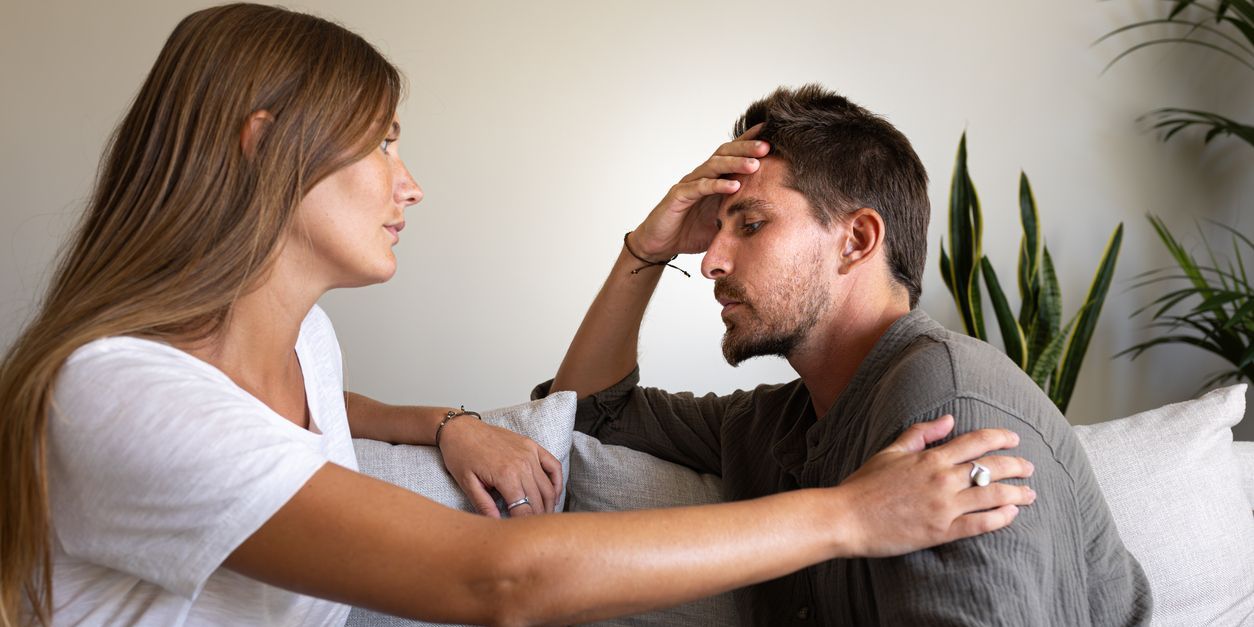
Summary: There are several ways to help your partner with their anxiety. The most important first step may be understanding that anxiety is not a choice: they don’t want to be anxious and spend their time dealing with/managing symptoms of anxiety and would rather do almost anything else.
Key Points:
- Anxiety is one of the most common mental health problems worldwide.
- Severe anxiety that reaches a clinical threshold is disruptive and can impair daily activity, but mild and moderate anxiety can also be disruptive, as well.
- When a partner has anxiety, listening without trying to fix the situation can help more than jumping in with advice.
- Offering a calm, reassuring presence while they talk through what’s going on with them may be exactly what your partner needs.
Anxiety and Anxiety Disorders: Basic Facts
Experts from the National Institutes of Health (NIH) report one symptom/state of mind common to all types of anxiety disorders:
“Persistent, excessive fear or worry in situations that are not threatening.”
That’s a good initial way to understand anxiety. It’s when a person worries about or is afraid of something that for most people – or people without anxiety – would not cause significant fear or worry.
Here’s a slightly more detailed definition from the American Psychological Association (APA):
“Anxiety is an emotion characterized by apprehension and somatic symptoms of tension in which an individual anticipates impending danger, catastrophe, or misfortune.”
And finally, here’s a clinical definition of anxiety disorder provided by Diagnostic and Statistical Manual of Mental Disorders (DSM-5):
“Excessive anxiety and worry (apprehensive expectation), occurring more days than not for at least 6 months, about a number of events or activities (such as work or school performance).”
The symptoms of anxiety typically appear in two types: emotional/psychological and physical.
Emotional/psychological symptoms of anxiety may include:
- Fear of common events or circumstances
- Constantly feeling on edge
- Daily feelings of restlessness
- Persistent anger/irritability
- Consistently predicting or expecting the most negative possible outcome for any upcoming situation
Physical symptoms of anxiety may include:
- High level of tension in joints and muscles
- Shallow, fast breathing while under stress
- Persistently elevated heart rate
- Nagging problems such as headaches or nausea that have no obvious physical origin/cause
- Chronic fatigue
- Persistent sweating
- Tremors, shakiness, twitching
That’s what clinical anxiety is, and the most common side effects associated with generalized anxiety disorder (GAD).
Next, let’s see how many adults in the U.S. have anxiety.
The 2024 National Survey on Drug Use and Health (2024 NSDUH) shows the following prevalence rates for anxiety among adults in the U.S.:
Anxiety Among Adults in the U.S. in 2024
- Mild anxiety: 37.5 million
- Just over 14% of adults
- Moderate anxiety: 12.2 million
- Almost 5% of adults
- Severe anxiety: 7.1 million
- Almost 3% of adults
As you can see, millions of people in the U.S. have anxiety. They report symptoms on a continuum from mild to severe. The good news is that anxiety is a treatable diagnosis, and with the right combination of therapeutic techniques and support, people with anxiety can learn to manage their symptoms and prevent their anxiety from interfering with living a full, productive, and happy life.
What to Do When Your Partner Has Anxiety
Before I share my tips, I want to remind people that anxiety can be contagious – especially for an empathic person or for a person who has a proclivity to anxiety. Humans are social beings, and our attitudes, moods, and demeanors have the tendency to rub off on one another, particularly the people we’re close to. This includes when we’re feeling worried or concerned about something.
Therefore, if you have a partner with anxiety, I encourage you to check yourself, too: to support them, you need to come from a calm, relaxed, supportive place. Sometimes what your partner needs is just to look at you and see you as their rock, before you say or do anything at all. That’s where to start: you can act as a grounding rod for them, and that means you need to be solid, yourself.
How to Help Your Partner With Anxiety: Seven Tips
1. Make Your Home Environment Peaceful
An excellent way to support a partner with anxiety is to prioritize making your home a relaxing place to be. You don’t have to keep it hospital-level clean, but having a home space that’s neat, organized, and uncluttered can make a big difference. Other ways to make your home more relaxing include buying houseplants, displaying creative art, or using candlelight in the evening. Also remember that music – whatever they find relaxing – is a great way to keep the home calm and peaceful.
2. Be Mindful of How You Talk
When your partner displays signs of anxiety, avoid saying things like “What’s your problem?” Try a more compassionate approach, like “Is something big happening for? Help me understand.” If they’re freaking out about something, definitely don’t tell them to “Relax.” That backfires almost every time. Instead, make a proactive suggestion, and do say something like: “How about some mindful breathing.” If they’re obviously having trouble with something, avoid telling them, “It’s okay, everything is okay.” Try something more like this: “We can work this through together.” And if they’re clearly worried about something, please don’t say “That’s no big deal.” Try something more like this: “Tell me more about what’s happening. I want to help.”
3. Validate Without Enabling
It’s important to recognize and validate your partner’s emotions without encouraging, adding to, or enabling their anxiety. For instance, when you say something like, “I can tell something is going on with you. Please tell me about it,” you acknowledge and validate their feelings. When you say, “We can work through this together and find a solution,” you validate their feelings and get them moving toward taking positive steps to process their thoughts and emotions – i.e., their anxiety – in a positive and productive manner.
4. Help Them Find Professional Support
For a person with an anxiety disorder, professional therapy and counseling can be life changing. There are several modes of psychotherapy that work very well for anxiety, including:
Cognitive behavioral therapy (CBT):
-
- CBT helps people reassess, revise, and reframe the things that make them anxious. Through a process called cognitive reframing, CBT helps people see things from new angles, with greater perspective, and a mindset that reduces worry and anxiety. The same technique can also help people rewrite habitual, negative self-talk and negative ideas about themselves that contribute to anxiety.
Dialectical behavior therapy (DBT)
-
- DBT is a type of therapy derived from CBT. DBT therapists can help your partner deal with the stress and psychological distress associated with anxiety by teaching them specific mindfulness technique adapted for the therapeutic context. DBT is particularly effective for people who are highly emotionally reactive and need help managing overwhelming emotions.
Prolonged exposure therapy (PE)
-
- In this type of therapy, a skilled therapist follows a safe, stepwise, gradual process of helping patients address fears and talk through anxieties. Though repeated exposure and discussion in a safe and supportive environment, the therapist works with the patient until things that previously caused fear and anxiety lose their power, and no longer elicit the same powerful emotions.
Eye movement and desensitization and reprocessing (EMDR)
-
- In EMDR therapy, specially trained psychotherapists combine gradual exposure associated from PE with adaptive information processing (AIP) in order to decouple memories from painful emotions, reprocess those memories, and store them in a way that no longer causes fear, worry, or anxiety. EMDR and PE are most commonly used for people with severe anxiety or complex trauma.
5. Love, Support, and Teamwork
Offering your partner unconditional love and support can make all the difference in the world. You can say to them, “I love you, I’m here for you, and whatever you need, I’ll do it. You can learn how to deal with this and I’ll be right here by your side the entire time.” It’s one thing to read things like “millions of people have anxiety – you are not alone,” but it’s completely different when a real, live human being stands in front of you and offers supportive words. Big, comforting hugs – only possible in person – can work wonders as well. For someone with anxiety, love and compassion – without enabling – win every time.
At the same time, they need to understand that you have your limits. Come up with ideas and agree on ways they can handle their anxiety when you need your space after a bad day. They can go for a walk, work through things, and you’ll be there when they get back. Or you can go for a walk, de-stress yourself, and be for them when they come back. Either way, the key is to talk about things and agree on how you’ll deal with things when circumstances aren’t ideal. Having an agreed upon system can reduce stress for both of you, and act as an external framework to keep you both at your best.
6. Take Care of Yourself, Too
If your partner has an anxiety disorder, you need to remember to take care of yourself, too: this is really what we’re hinting at, above. You want to help them, love them, and support them, but unless you’re a professional therapist, it’s not your job to be their therapist. That sentence seems redundant, but think about it. As a layperson, you can only do so much. Beyond that, they need to learn to navigate their anxiety independently.
If they’re in therapy and you know a little bit about the techniques they learn, you can remind them to use them, rather than you, to process their emotions. That’s not callous – that’s empowering. When you give them the time and space to work through whatever is going on in the moment, that shows you trust them and believe in them. Tell them you’re there for them – literally right there – and you know they can apply their skills to get past this moment.
7. Create Personalized Systems – And Stick to Them
If your partner has anxiety and you don’t create healthy boundaries for yourself, you may get exhausted, overwhelmed, and in some cases, just as stressed as the partner with anxiety. To avoid this, take care of yourself. Make and maintain boundaries, be consistent, and follow through. When you make and keep healthy and consistent boundaries, it empowers and encourages your partner to manage independently, which is the real goal in any partnership: two people mutually reinforcing one another to be the best possible version of themselves.
Supporting Your Partner: Resources for Anxiety Treatment
To learn about the various types of anxiety diagnoses identified by mental health experts, and the types of treatment for anxiety we offer at Crownview Co-Occurring Institute, please read our anxiety treatment page:
Anxiety Treatment For Men and Women with Co-Occurring Disorders
If you read this article and decide your partner needs professional support for anxiety, please don’t hesitate to contact us today. Our team of skilled, experienced therapists offer a wide range of innovative therapies that can help.
If you’re not in our area, please refer to the following resources to find professional support to help your partner with their anxiety:
- The National Alliance on Mental Illness (NAMI): Find a Professional
- The National Institute of Mental Health (NIMH): Finding Treatment
- The Substance Abuse and Mental Health Services Administration (SAMHSA): Finding Help
- American Psychiatric Association (APA): Treatment Locator
 Kimberly Gilkey, RADT-1
 Amanda Irrgang, Registered Dietitian Nutritionist (RDN)
 David Abram
 Emily Skillings
 Michelle Ertel
 Alexandria Avalos, MSW, ACSW
 Jovanna Wiggins
 Kelly Schwarzer
 Timothy Wieland
 Amy Thompson
 Gianna Melendez
 David Dalton, Facility Operations Director
 John P. Flores, SUDCC-IV-CS, CADC II
 Jodie Dahl, CpHT
 Christina Lam, N.P.
 Kathleen McCarrick, MSW, LSW
 Alexis Weintraub, PsyD
 Jordan Granata, PsyD
 Joanne Talbot-Miller, M.A., LMFT
 Brittany Perkins, MA, LMFT
 Brieana Turner, MA, LMFT
 Milena Dun, PhD
 Rebecca McKnight, PsyD
 Laura Hopper, Ph.D.
 Nathan Kuemmerle, MD
 Jeffrey Klein
 Mark Melden, DO/DABPN